|
Posted on February 20, 2026 @ 12:35:00 PM by Paul Meagher
The new year is often a time to think about acquiring new habits and getting rid of old habits. Before finalizing any resolutions, I thought it might be better to first read some books on habit formation to help improve the odds of successful habit change.
The most popular recent book on habit formation is Atomic Habits: An Easy & Proven Way to Build Good Habits & Break Bad Ones (2018) by James Clear. Before
Atomic Habits came out, the most popular book on habit formation was The Power of Habit: Why We Do What We Do In Life And Business (2012) by Charles Duhigg.
I decided to start my reading on habit formation with Charles Duhigg's Power of Habit book.
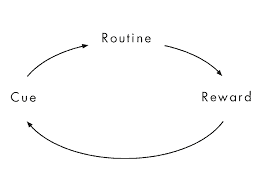
One of the main contributions of the Power of Habits book was to popularize the idea of the Habit Loop concept with this diagram:
One difference between the Power of Habits and Atomic Habits book is that the Power of Habits applies the habit loop concept to understanding and solving business problems whereas Atomic Habits is more focused on applying the habit loop to self improvement. Atomic Habits is more likely to appear in the self-help section of a bookstore, Power of Habits in the business books section.
In this blog, I want to focus on one business problem Duhigg applies the habit loop concept to: advertising a product or service.
In the habit loop diagram above, the idea is that a cue triggers a routine that results in a reward. The reward reinforces the association between habit loop components. When developing an ad for a product or service, one approach is to imagine a habit loop the product or service might play a role in. If you are selling tooth paste, that means defining the cue (or trigger) that makes people engage in the routine of brushing their teeth (e.g., a film on their teeth, going to bed, waking up, finishing a meal, etc...), and the reward that the customer will experience if they use product or service (e.g., improved smile, white teeth, better health, etc..). The advertisement would consist of showing
people a cue that triggers the use of your product or service and the reward they will get if they use your product or service (as part of the routine that delivers the reward). If your ad is successful in conveying a habit loop that resonates with the customer, it could lead the customer to purchasing your product or service. If the cue occurs quite frequently in the course of their day then even better as there are more opportunities to sell your product or service to them. For example, if the cue for brushing your teeth is when you finish a meal, and the reward is fresh breath, then there are lots of opportunities for the customer to use your product and hopefully become a regular consumer of your product. A recurring customer for a product or service is the ideal.
Here we see how the concept of a habit loop can be used to guide us in our advertising efforts. The job of the advertiser is to identify the cue for using your product or service and the reward the customer will obtain when they use your product or service. The cue or the reward may not be obvious. Duhigg discusses how Proctor and Gamble employed an advertising team to come up with the best approach to selling a new product they developed: Fabreze. They originally thought the cue was a bad smell, the routine was spraying the thing causing the bad smell with Fabreze, and the reward was the elimination of the odor. Turns out that conveying that story in their advertising didn't sell very well. They eventually discovered that a better habit loop showed the cue of cleaning your home, the routine was a cleaning action that ended with using their product on the cleaned item, and the reward was a cleaned area that not only looked good but smelled good. The ad team only came up with this cue, routine, reward story because they were visiting people who they gave the product to and were using it, and discovered a person who liked to spray cleaned items with Fabreze because it increased the perceived reward of her cleaning efforts (looks and smells great).
The grandfather of advertising, Claude Hopkins (1866-1932), launched many successful brands. Duhigg discusses his success in launching Pepsodent tooth paste. When creating ads for Pepsodent he did alot of research to identify the best cue and reward for his client's Pepsodent tooth paste product. His success in making Pepsodent a brand leader in tooth paste suggests that the simple 3 stage habit loop framework above can be used to help guide ad development.
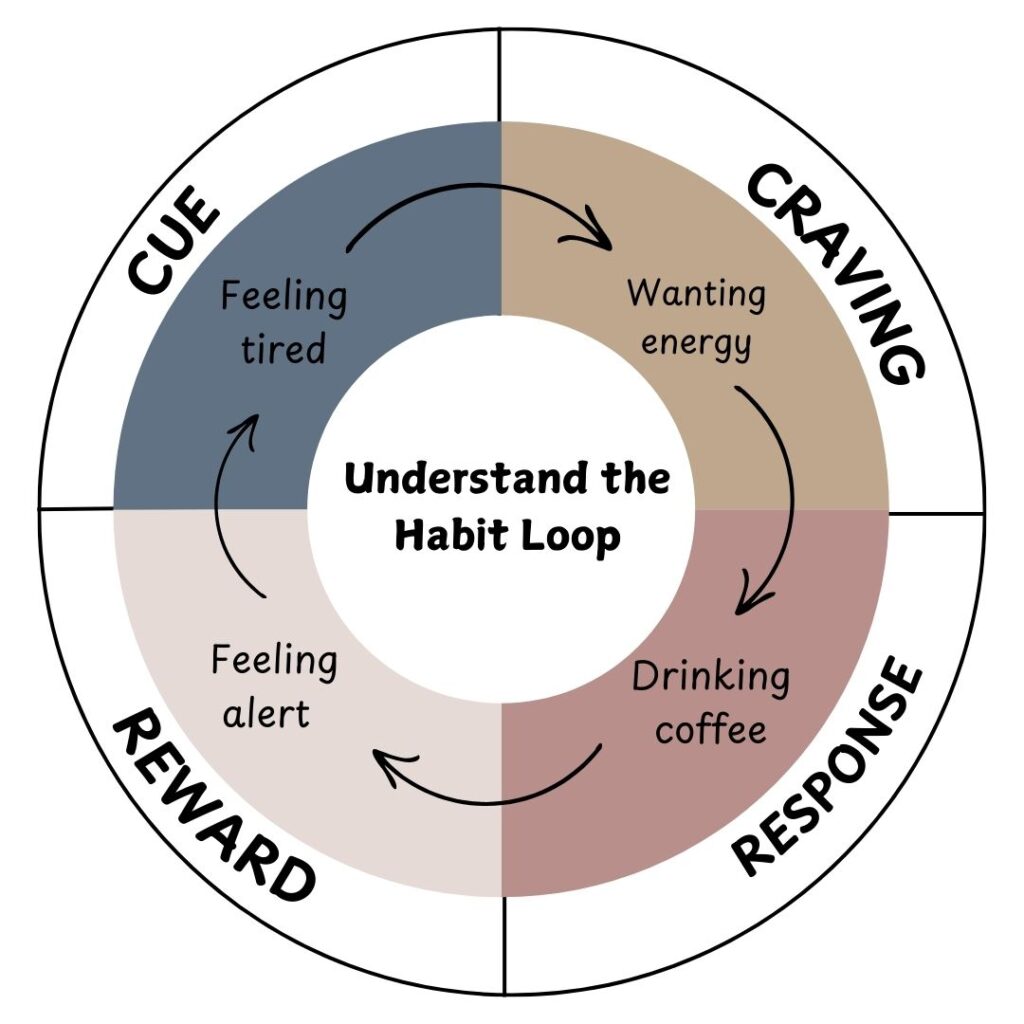
Duhigg complicates the habit loop story by pointing out that craving often preceeds the routine and motivates people to engage in the behavioral routine that will deliver the reward. After associating a cue with a reward, our brain starts to anticipate the reward and brain activity that used to be associated with the reward occurs before the reward is achieved. This brain activity can be interpreted as craving the reward. Duhigg views craving as "driving" the loop - it appears as embedded in the middle of the loop. James Clear views "craving" as a stage (stage 2) that falls between the cue (stage 1) and the routine (stage 3) which motivates a person to engage the routine. The reward is Stage 4 in Clear's framework. The diagram below uses the example of coffee drinking to convey Clear's 4 stage habit loop.
Source: https://readtraverse.com/atomic-habits-summary
One approach to creating an advertisement, might be to create a habit loop diagram for the product or service you want to sell that is similar to the coffee habit loop diagram which has short descriptions for each stage. Once you feel comfortable with the descriptions for habit loop stages, you can proceed to develop an ad that incorporates this habit loop information.
Advertising is not my area of expertise. Many people develop ads without having any theoretical approach guiding them. I don't know if different approaches to ad development produce better results than others. What impressed me about the Habit Loop approach is that it gives you fairly clear guidance on the type of research you might want to do before creating an ad: figuring out how your product or service fits into a habit loop diagram as a first step and then using that habit loop diagram to help you develop the ad.
|
 $175,000 at 10.00% fixed; 110 semi-monthly payments of $2,000


